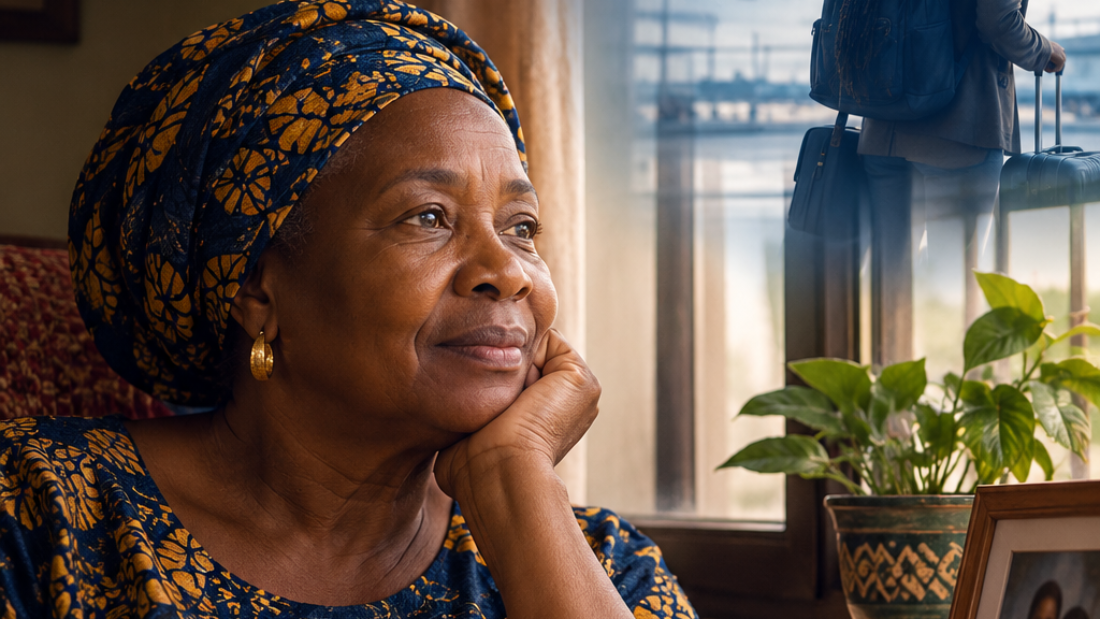
International migration is often examined through the aspirations of those who leave: the search for better opportunities, economic security, improved living conditions, and the possibility of building a better future for themselves and their families. Yet, behind these migration journeys are family members who remain at home, negotiating the consequences of physical separation, changing family relationships, and the reorganisation of care. Among those who experience these changes are older parents whose children have migrated internationally.
My recently published article, “Left Behind and Reimagined: Identity Reconstruction and the Social Burden of Children’s Migration on Older Adults,” co-authored with Kezia Batisai and published in Frontiers in Sociology, examines this often-overlooked dimension of international migration.
Drawing on in-depth interviews with older adults who have migrant children, the study explores how the international migration of adult children reshapes their lives, identities, relationships, and well-being as parents who remain in their places of origin. Using the transnational social field perspective, we sought to understand not simply what older adults lose when their children migrate, but also how they negotiate, reconstruct, and make meaning of their changing circumstances.
Beyond the economics of migration
Migration research frequently privileges the economic benefits of migration, particularly remittances, improved household income, and migrants’ financial contributions to families and communities back home. While these contributions are important, they do not necessarily replace the everyday presence, companionship, and practical care that older parents may have previously received from their children.
Our findings reveal this complexity.
Although remittances sometimes improved the material circumstances and community standing of older adults, they did not necessarily compensate for the absence of children, particularly when parents experienced illness, loneliness, emotional distress, or difficulties accessing everyday care.
The study identified three interconnected dimensions of this experience: migration as a social determinant reshaping care, well-being, and identity; migration as a socially constructed experience; and migration as a gendered phenomenon reshaping roles, identities, and vulnerabilities.
One particularly important finding was that older adults did not necessarily interpret their children’s migration as abandonment. Many understood it as an economic necessity and expressed pride in their children’s achievements, even while navigating the emotional costs of separation. Their experiences were therefore characterised by a duality of pride and loss.
We also found that religious and community institutions played important roles as alternative support systems. For some participants, these institutions provided social connection, spiritual reassurance, and forms of support that helped them navigate the absence of their children.
However, these possibilities were not equally available. Older adults with access to remittances, regular transnational communication, and supportive community networks were better positioned to reconstruct their identities and social standing. In contrast, those with limited resources, particularly widowed women living with illness, often experienced the burdens of migration without necessarily benefiting from its compensations.
A personal reflection: When research findings become familiar
There is a dimension of this research that has become particularly meaningful to me, one that I could not have anticipated when we were conducting the study.
At the time of the research, I was still at my point of origin, where the study was also conducted. I was engaging with older adults, listening to their accounts of having children living abroad, their changing family relationships, their experiences of separation, and the emotional and practical implications of having to navigate ageing without the physical presence of their children. I approached these narratives as a researcher, seeking to understand the social processes shaping their experiences.
I had no idea that I would later become a migrant myself, or that I would come to resonate so deeply with some of the experiences participants had shared with us.
Today, as a migrant with an elderly mother at home, I find myself reflecting on those interviews from a somewhat different position. The narratives I once listened to as research data have acquired another layer of meaning. I have a more immediate appreciation of what physical distance can mean for an ageing parent, the emotional weight of not being physically present, and the limitations of trying to provide care, reassurance, and support across geographical boundaries.
I know, in my own way, how it feels to have an elderly mother at home while navigating life and responsibilities elsewhere. I think about the everyday things that physical presence makes possible, the reassurance of being able to check in personally, the ability to respond to immediate needs, and the ordinary moments of companionship that cannot always be recreated through telephone calls, video conversations, or financial support.
This is not to suggest that my circumstances are identical to those of the participants. Rather, it has deepened my appreciation of the complexities they described. It has also reminded me that migration is not simply an individual decision or a geographical movement. It is a family and social process whose consequences extend across borders and generations.
Perhaps one of the most significant lessons for me is that research sometimes takes on meanings beyond what we initially anticipate. We enter the field with questions, theoretical frameworks, and methodological objectives. We listen, interpret, analyse, and write. Yet, life can subsequently place us in positions that allow us to understand some of those findings in ways we could not have imagined when the research was undertaken.
For me, this has reinforced the importance of reflexivity in sociological research and the need to pay closer attention to the relationships between researchers, research participants, and the social realities being investigated.
Reimagining parenthood across borders
Beyond documenting the burdens associated with children’s migration, the study makes an important conceptual contribution through the idea of left-behind transnational parenthood.
We use this concept to explain how parenthood, care, and social standing are reorganised from the origin side of the transnational social field. In other words, parenthood does not cease to be actively performed simply because children have migrated. Instead, the relationships, expectations, responsibilities, and identities associated with being a parent are renegotiated across geographical boundaries.
Some older adults reconstructed their identities as transnational parents and community benefactors, drawing on their children’s achievements, financial contributions, and continued connections. Others experienced a more difficult reality in which the absence of children intensified existing vulnerabilities.
This distinction is important because it challenges the tendency to treat older adults left behind as a homogeneous population. Their experiences are shaped by gender, marital status, health, economic circumstances, access to remittances, and the availability of social support.
It also calls for a more nuanced understanding of ageing in societies experiencing significant international migration. The question should not only be what migrants contribute to their families and countries of origin, but also what happens to those who remain behind and how their care needs, emotional well-being, and social identities are transformed.
Why this research matters
As international migration continues to reshape family structures across sub-Saharan Africa, the experiences of older parents deserve greater attention in migration, ageing, family, and public health scholarship.
The findings have implications for social protection, community-based support systems, ageing policies, and interventions aimed at improving the well-being of older adults. They also highlight the importance of recognising that remittances, although valuable, cannot independently address the social and emotional dimensions of care.
For me, this publication represents more than another addition to my research portfolio. It is a reminder of the importance of asking questions about the people and relationships that are often less visible in mainstream migration discussions.
It is also a reminder that behind every migration statistic, remittance transaction, and narrative of opportunity are families negotiating distance, responsibility, love, loss, and changing expectations.
I hope this research contributes to broader conversations about migration and its consequences for ageing populations, particularly those whose lives continue to be shaped by the migration decisions of their children.
Read the full open-access article:
Ani, J. I., & Batisai, K. (2026). Left Behind and Reimagined: Identity Reconstruction and the Social Burden of Children’s Migration on Older Adults. Frontiers in Sociology.