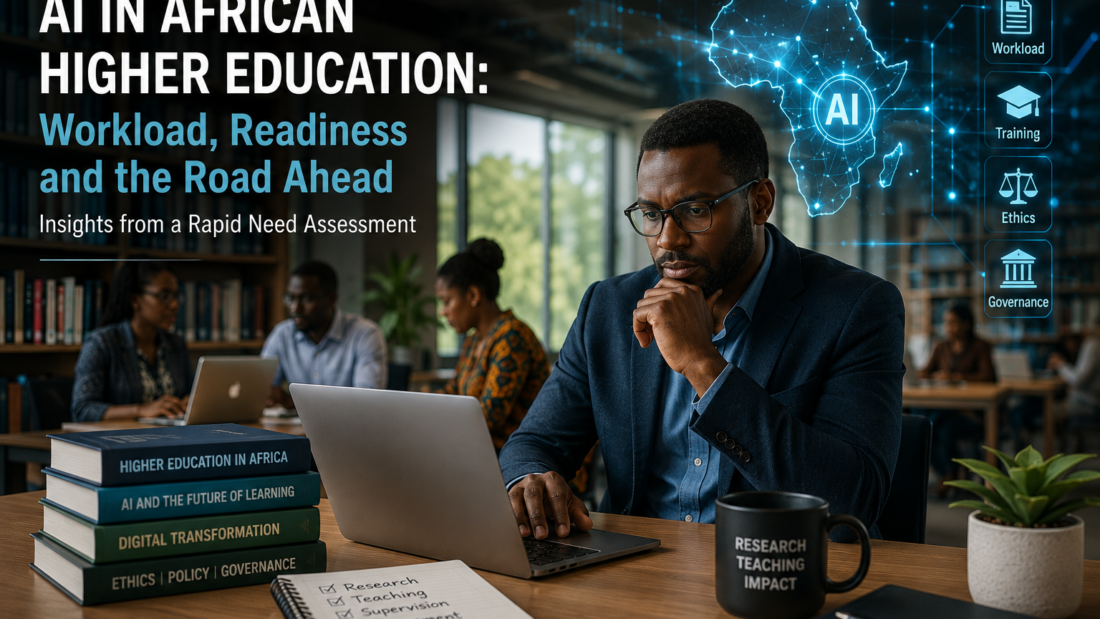
Artificial intelligence (AI) is no longer a futuristic concept in African universities. It is already reshaping how academics teach, conduct research, supervise students, assess learning, and manage increasingly demanding workloads. Yet an important question remains: Are our institutions evolving as quickly as the technology itself?
This question inspired our recently published study titled “Artificial Intelligence, Academic Workload and Institutional Readiness in African Higher Education: A Rapid Need Assessment.
Why we conducted this study
Across Africa, higher education institutions are under growing pressure to expand access, improve research productivity, enhance teaching quality, and meet increasingly complex accreditation and reporting requirements. At the same time, generative AI tools have rapidly entered academic life, offering new opportunities to improve efficiency while raising equally important questions about ethics, governance, and academic integrity.
Rather than asking whether academics are using AI, we wanted to understand a broader question: Are African universities institutionally prepared for responsible AI adoption?
What we found
Our findings paint a picture of both opportunity and urgency.
Most respondents reported experiencing substantial workload pressures across nearly every aspect of academic work, including research writing, lecture preparation, postgraduate supervision, assessment and grading, student support, institutional reporting, and accreditation-related responsibilities.
Against this backdrop, AI has already become part of everyday academic practice.
- 80% of respondents reported currently using AI tools.
- Yet only 23.3% had received any formal training in AI or digital technologies.
- Encouragingly, 96.7% expressed a strong interest in receiving structured training in generative AI.
These findings reveal a significant readiness gap. Many academics are adopting AI independently, often without institutional guidance, formal capacity building, or clear governance frameworks.
Where academics see the greatest value
Respondents identified several areas where AI could meaningfully support academic work:
- Research assistance and literature synthesis
- Academic writing and content development
- Grading and assessment support
- Personalised learning
- Curriculum planning
These findings suggest that academics view AI primarily as a tool for enhancing productivity rather than replacing human expertise.
Responsible adoption remains essential
Our study also highlights that enthusiasm for AI is accompanied by legitimate concerns.
Participants consistently identified issues relating to:
- Academic integrity
- Data privacy
- Accuracy and reliability
- Limited AI training
- Potential job displacement
These concerns reinforce an important point: successful AI integration requires more than access to technology. It requires institutions to establish robust governance systems that promote responsible, ethical, and contextually appropriate use.
What this means for African universities
Our findings suggest that institutional readiness must extend beyond technological infrastructure.
Universities should prioritise:
- Comprehensive AI policies and governance frameworks
- Continuous professional development for academic and administrative staff
- Clear ethical guidelines for teaching, research, and assessment
- Human oversight in AI-supported academic processes
- Strong data protection and privacy mechanisms
- AI strategies that reflect African educational contexts and development priorities
The conversation should therefore move beyond whether AI should be adopted toward how it can be integrated responsibly while strengthening teaching, research, and institutional effectiveness.
Looking ahead
Artificial intelligence presents one of the most significant transformations in higher education in decades. For African universities, it offers an opportunity not only to reduce administrative burdens but also to rethink teaching, research, knowledge production, and institutional innovation.
However, technology alone cannot transform higher education.
That transformation depends on thoughtful leadership, evidence-informed policy, ethical governance, and sustained investment in people.
Our hope is that this study contributes to that ongoing conversation by providing empirical evidence that can support universities, policymakers, and higher education stakeholders in building AI-ready institutions that are both innovative and responsible.
Citation
Igiri, C. P., Ani, J. I., Osabuohien, E., Nwokocha, E. E., Ajayi, G. O., Nyaga, J. G., Correia, O., & Akindele, M. A. (2026). Artificial intelligence, academic workload and institutional readiness in African higher education: A rapid need assessment. The Nigerian Journal of Sociology and Anthropology, 24(1), 28–49. doi.org/10.36108/NJSA/6202.42.0120