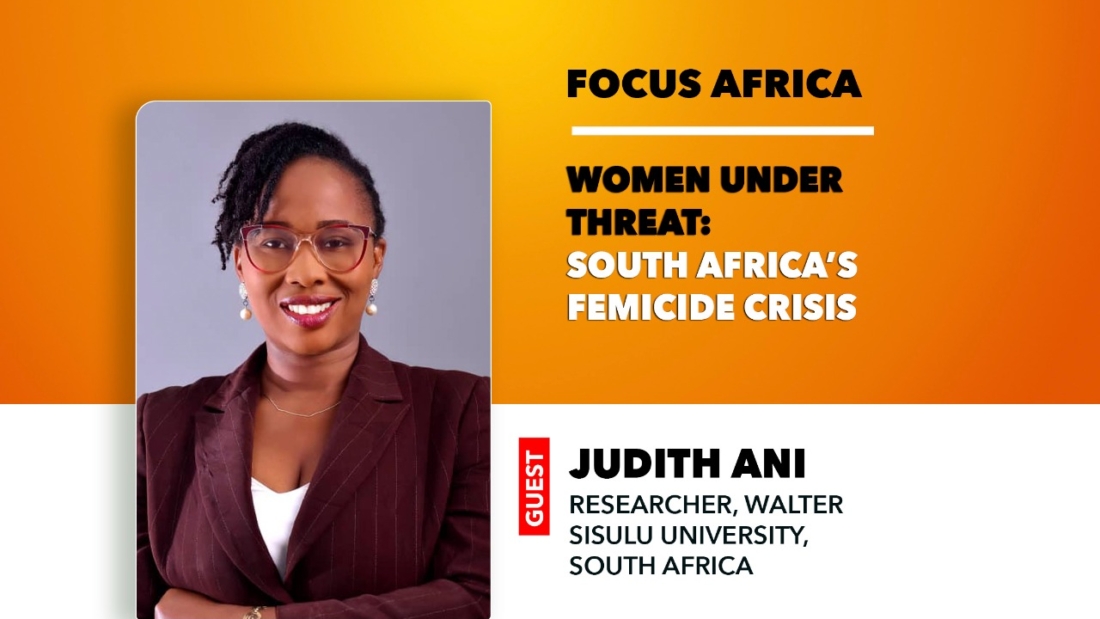
I recently had the opportunity to speak on News Central TV on the subject of “Women’s Safety Across Africa and a Call for Justice and Safety for Women.” The conversation came at a time when femicide and gender-based violence continue to demand urgent public attention – not only in South Africa, but across the African continent.

As I reflected on the discussion afterwards, one question stayed with me:
When a woman is killed, should our first question only be, “Who killed her?” Or should we also be asking, “What happened before she was killed, and could her death have been prevented?”
That shift in questioning is important.
Because femicide does not always begin with a murder. In many cases, violence exists long before a woman loses her life.
Understanding femicide
Femicide refers broadly to the intentional killing of women and girls because of their gender. It can occur within intimate relationships or outside them.
In South Africa, the evidence is particularly concerning. The national analysis of four femicide surveys found that the intimate-partner femicide rate reached 5.5 per 100,000 women in 2020/21. The study found that intimate partners remained the leading perpetrator category, accounting for 57.5% of cases in the weighted analysis.
The same research shows another troubling pattern. The proportion of cases in which police investigations did not identify a perpetrator increased from 18.6% in 1999 to 44.2% in 2020/21.
These numbers are not simply statistics. Behind every number is a woman whose life ended, a family that lost someone, children who may have lost a mother, and communities left to deal with the consequences.
They should therefore make us ask difficult questions about prevention, investigation, protection and accountability.
A woman may not move directly from safety to death
One of the most important things we must understand about femicide is that it can be connected to a wider continuum of violence.
Before a woman is killed, there may have been threats to kill her, physical assault, sexual violence, stalking, coercive control, financial control, isolation, intimidation, extreme jealousy or threats associated with separation and relationship breakdown.
This does not mean that every woman who experiences these forms of violence will be killed. Nor does it mean that every femicide can be predicted.
But it does mean that warning signs matter.
When a woman reports violence, makes a complaint, seeks medical attention, approaches the police, goes to a shelter, confides in family members or attempts to leave an abusive relationship, these interactions can represent important opportunities for intervention.
The question is whether our systems recognise those opportunities and respond effectively.
Beyond asking “Who killed her?”
The criminal justice system must identify perpetrators, investigate cases, prosecute offenders and ensure accountability.
But justice after a woman has been killed is not the same as safety before she is killed.
This is why we need to move beyond the question of “Who killed her?” to also ask:
What happened before she was killed?
Were there warning signs?
Had she previously sought help?
Did anyone know she was at risk?
Was there an opportunity for intervention?
Did the police, health system, family, community or other institutions have information that could have been acted upon?
And ultimately:
Could her death have been prevented?
These are not questions designed to shift responsibility onto victims. Quite the opposite.
They force us to examine the systems around women and ask whether those systems are functioning as they should.
From reaction to prevention
South Africa has developed important policy and institutional mechanisms to address gender-based violence and femicide. The National Strategic Plan on GBVF provides a multisectoral framework, and the National Council on GBVF has been established in law to provide strategic leadership and coordination.
The challenge, therefore, is not simply the absence of policies.
The more difficult question is:
How effectively are these commitments being translated into protection and prevention on the ground?
A woman does not experience a policy document.
She experiences the police officer who receives her complaint.
She experiences the healthcare worker who attends to her injuries.
She experiences the shelter that either has space for her or does not.
She experiences the family member who believes her – or tells her to return to the relationship.
She experiences the community that either intervenes – or remains silent.
And she experiences a justice system whose effectiveness may determine whether a threat escalates or is stopped.
This is why prevention requires more than awareness campaigns.
It requires functioning systems.
The importance of the Femicide Review Pilot
There is an important development in South Africa that deserves attention: the Femicide Review Pilot, formally launched in August 2026.
The pilot is being implemented in Gauteng, KwaZulu-Natal and the Eastern Cape. Its purpose is not simply to investigate individual murders as criminal cases. It is designed as a learning process—to examine what happened, identify systemic gaps, strengthen coordination and determine how lessons from individual cases can inform prevention.
This is an important shift in thinking.
A femicide review should encourage us to examine the circumstances surrounding a woman’s death and the institutional responses that preceded it.
Where were the warning signs?
Where did the system respond?
Where did it fail?
What information was available?
What information was missing?
What could have been done differently?
And most importantly:
What can we learn from this death that might help save another woman’s life?
The real value of such a mechanism should ultimately be measured not by how many cases are reviewed, but by whether the lessons from those cases lead to changes that prevent future deaths.
Safety is more than policing
When we talk about women’s safety, the conversation often becomes focused on policing and public spaces.
Those issues matter.
But women’s safety cannot be reduced to telling women to avoid certain places, change their behaviour, travel in groups, carry protection or remain constantly alert.
Women should be able to live, work, study, travel, form relationships and leave relationships without living under the constant threat of violence.
Safety must therefore be understood more broadly.
It includes prevention, early intervention, protection and access to support.
It requires stronger policing and forensic capacity. It requires effective reporting and surveillance systems. It requires accessible shelters and survivor services. It requires responsive healthcare systems. It requires communities that do not normalise violence. It requires research and reliable data. And it requires accountability when institutions fail to perform their responsibilities.
Communities are part of the prevention system
Government cannot do this alone.
Neither can the police.
Neither can civil society.
Communities matter because violence does not happen in isolation from social relationships and community structures.
Families, religious institutions, schools, workplaces, traditional and community leaders, healthcare providers, researchers and ordinary citizens all have a role to play.
Communities can recognise warning signs.
They can support women who disclose violence.
They can challenge harmful ideas about (hegemonic) masculinity and relationships.
They can report violence.
They can refuse to protect perpetrators through silence.
And they can help create environments in which seeking help is treated as an act of courage rather than shame.
But community responsibility must not become an excuse for governments and institutions to withdraw from their own responsibilities.
The state has obligations. Institutions have obligations. Communities have obligations. Individuals have obligations.
We need all of these levels working together.
The African conversation
Although South Africa receives significant attention because of its documented levels of femicide, women’s safety is not exclusively a South African issue.
Across Africa, women and girls experience different forms of violence shaped by social, economic, cultural, political and institutional circumstances.
The African Union’s adoption of the Convention on Ending Violence Against Women and Girls (AU-CEVAWG) in February 2025 represents an important continental commitment to preventing and responding to violence against women and girls. The Convention is intended to strengthen legal and institutional mechanisms and address the root causes and drivers of violence.
But adoption of a continental instrument is only one part of the journey.
The real test lies in implementation, financing, enforcement and accountability.
African countries need to translate commitments into functioning systems that women can actually experience in their everyday lives.
Justice after death. Protection before death.
There is a tendency to think about justice primarily in terms of what happens after a crime.
Investigation.
Arrest.
Prosecution.
Conviction.
Accountability.
All of these matter.
But if our goal is women’s safety, we must also think about what happens before the crime becomes lethal.
Prevention.
Early intervention.
Protection.
Safe accommodation.
Survivor support.
Risk identification.
Community intervention.
Responsive healthcare.
Effective policing.
Accessible justice.
This is why I see women’s safety through four connected actions:
PREVENT → PROTECT → RESPOND → ACCOUNT
We must prevent violence before it occurs.
We must protect women who are at risk.
We must respond effectively when violence occurs.
And we must hold perpetrators—and where appropriate, institutions that fail in their responsibilities—accountable.
We should not wait for another death to learn
Every woman who is killed leaves behind more than a crime scene.
Her death leaves questions.
Was she afraid before she died?
Had she asked for help?
Did someone know?
Was there a previous report?
Was there a medical encounter?
Was there a threat?
Was there a separation?
Was there a pattern of control?
Was there an institution that could have intervened?
These questions matter because prevention requires us to learn from what has already happened.
We should not wait until another woman is killed before we discover that the systems around her were not working.
Women should not have to die before the system learns that they were at risk.
The call for women’s safety across Africa must therefore be more than a call for justice after violence.
It must be a call for systems that protect women before violence becomes lethal.
It must be a call for evidence-based prevention, effective institutions, responsive communities and meaningful accountability.
And above all, it must be a commitment to ensuring that when we remember the women we have lost, we do not only remember how they died.
We ask what could have been done to keep them alive.
Because justice matters.
But safety before death is justice in its most preventive form.